

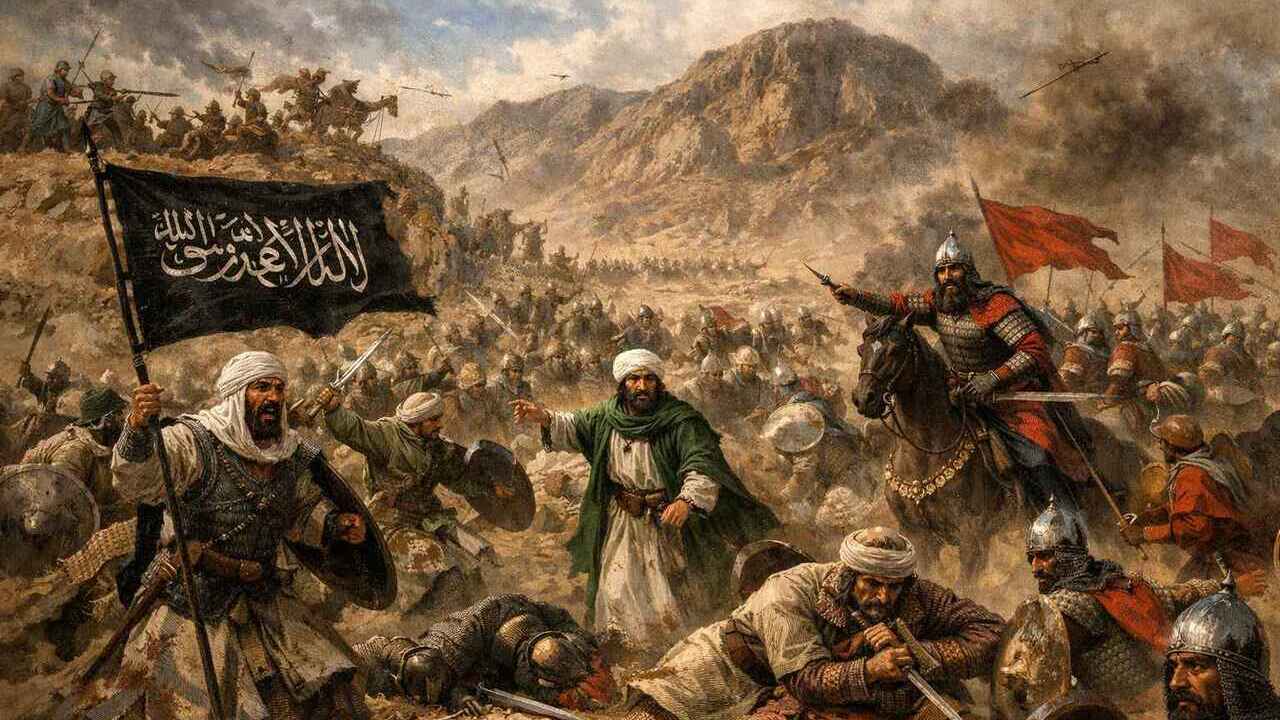
The valley of Uhud, a barren expanse north of Medina, stands as a silent witness to one of the most emotional fragments in human history. At the foot of the giant mountain, on a Saturday in the month of Shawwal, 3 AH (625 CE), a battle unfolded—not merely a clash of swords, but a spiritual struggle between faith, obedience, and the lure of worldly desires.
1. The Shadow of Badr and the Prophet’s Dream
The scars of defeat at the Battle of Badr a year prior still bled in the hearts of the Meccans. Abu Sufyan mobilized a massive force: 3,000 warriors, 200 cavalry, and 3,000 camels, funded by 50,000 dinars of trade profit.
In Medina, news of this reached Prophet Muhammad (peace be upon him) via secret intelligence. The Prophet had shared a heavy dream: his sword was notched, and cattle were being slaughtered. These were celestial signs that the blood of his family and dearest companions would be spilled. Although he initially advised staying within the city, the zeal of the young men—eager for martyrdom—led him to decide to meet the enemy at the foot of Mount Uhud.

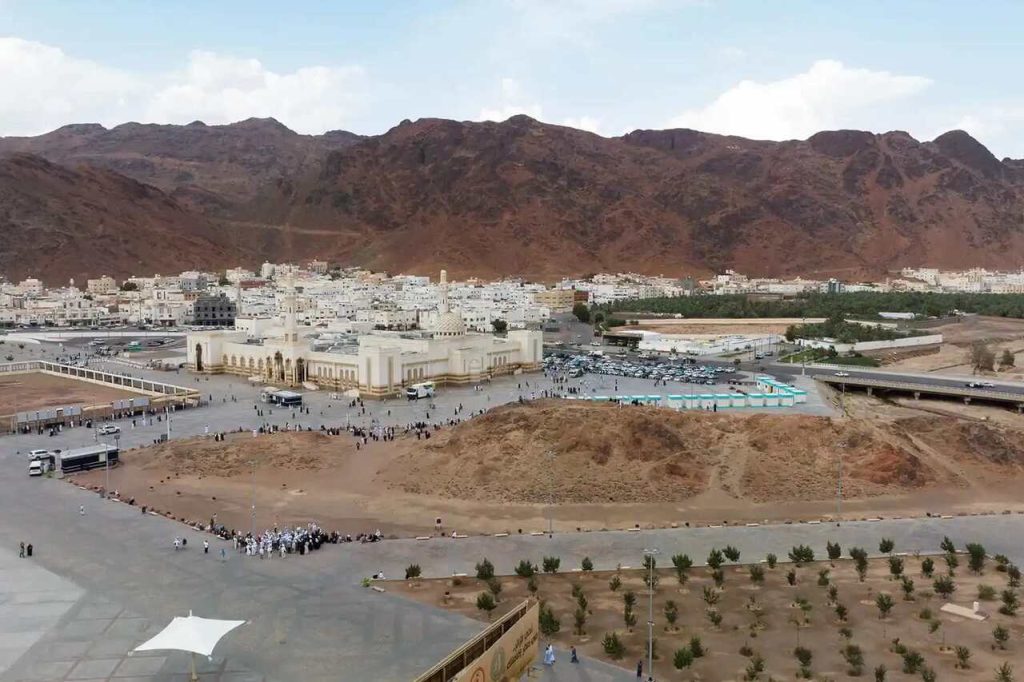
2. Strategic Brilliance at the Archers’ Hill
The Prophet positioned 50 of his best archers on a strategic hill, now known as Jabal Rumat. His instructions to the commander, Abdullah bin Jubair, were explicit and without exception:
“Protect our backs with a rain of arrows. Stay at your post, whether you see us winning and gathering spoils, or whether you see our corpses being torn by birds of prey. Do not move until my messenger arrives.”
Initially, the strategy worked perfectly. When the battle broke out, the arrows from the hill rendered Khalid bin Walid’s cavalry useless. The Muslim infantry on the plains surged forward like a storm, causing the Meccan army to flee in disarray, leaving behind their tents and treasures.
3. The Turning Point: The Lure of Worldly Spoils
Victory was within reach. However, atop the hill, the focus of the archers began to crack under the glitter of gold and enemy weapons scattered below. “Spoils! The war is over!” they cried. Despite Abdullah bin Jubair’s desperate shouts reminding them of the Prophet’s command, 40 of the 50 archers descended to claim their share.
Khalid bin Walid, the military genius who was then still on the side of the polytheists, saw this fatal opening. With swift cavalry movement, he circled back, occupied the abandoned hill, and ambushed the Muslim army from behind. The situation flipped in an instant; shouts of victory turned into cries of panic.
4. Nusaibah binti Ka’ab: The Shield of the Prophet
In the midst of the chaos, a false rumor spread that the Prophet had been killed. The Muslim ranks broke. Yet, at the center of the turmoil, Nusaibah binti Ka’ab (Ummu Umarah) emerged. Originally tasked with carrying water, she unsheathed her sword and grabbed a bow the moment she saw the Prophet in danger.
Nusaibah became a human fortress. She parried the sword of Ibn Qum’ah, who was attempting to strike the Prophet’s head. Her shoulder was slashed open by a deep wound, yet she did not flinch. The Prophet later testified that everywhere he turned, he saw Nusaibah fighting to protect him. Her courage stands as eternal proof that valor in faith knows no gender.
5. Mourning in the Valley: Hamzah and Mush’ab
The battle ended with 70 Muslim martyrs fallen. The Prophet found the body of his beloved uncle, Hamzah bin Abdul Muththalib, in a condition that broke his heart—his chest torn open and his organs mutilated by the vengeance of Hindun binti Utbah. He also found Mush’ab bin Umair, the noble envoy who was once a wealthy aristocrat, dead with a shroud that could not even cover his entire body.
The Prophet wept bitterly before their bodies. However, from this grief emerged a law of honor:
- Buried Without Washing: The martyrs were buried in their blood-stained war clothes. The Prophet declared that this blood would bear witness with the fragrance of musk on the Day of Judgment.
- The Hierarchy of Knowledge: When burying two or three people in one grave, the Prophet prioritized the body of the one who had memorized the most of the Quran. It was a message that knowledge and proximity to Revelation are the highest standards of nobility, even in the grave.
6. Epilogue: Eternal Lessons from the Mountain That Loves Us
Mount Uhud still stands tall in Medina today. The Prophet once said, “Uhud is a mountain that loves us, and we love it.” This love is a reminder that the failure at Uhud was not because God was unable to help, but because humans are often defeated by their own worldly ambitions.
Uhud teaches the world that a single act of disobedience to a leader’s command can bring down an entire structure of victory. It is a mirror for every generation: that behind every difficulty, there is a test of loyalty, and behind every drop of a martyr’s blood, there is a fragrance of paradise that time will never fade.


