

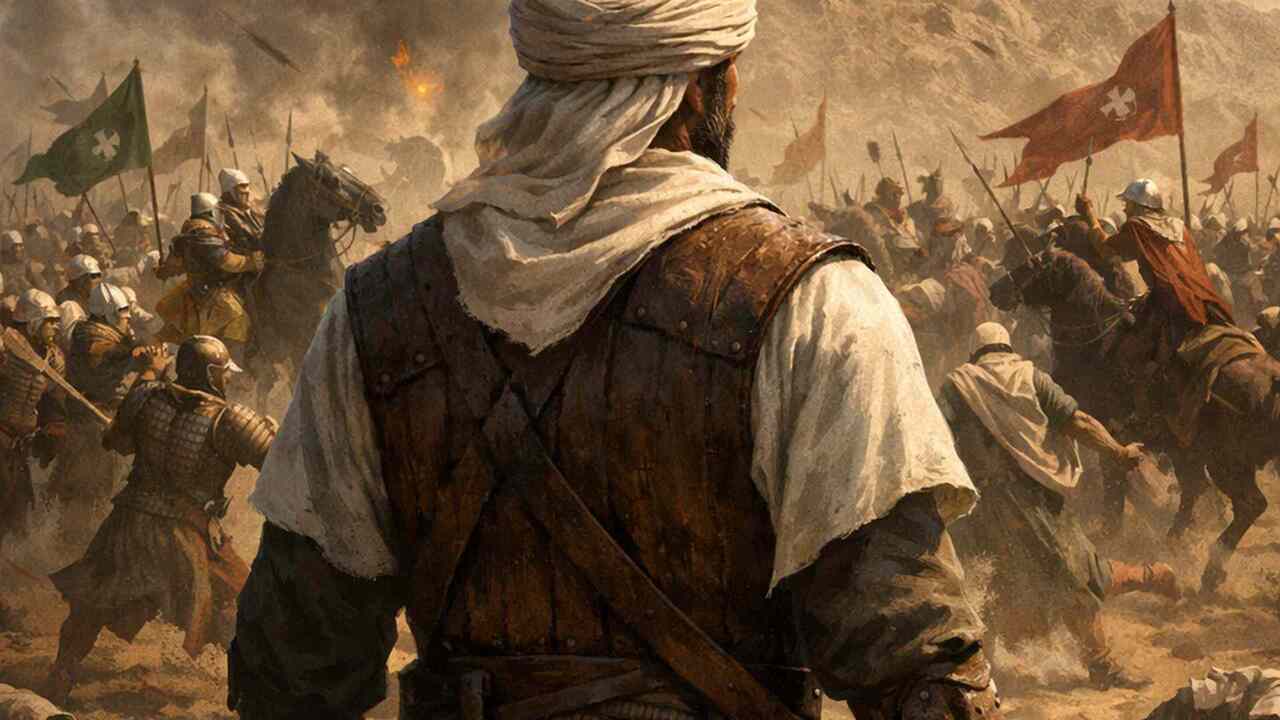
MADINAH – Islamic history is replete with tales of chivalry, but few carry the dramatic weight and emotional resonance of Hanzhalah bin Abi ‘Amir. Beyond the dust and din of the legendary Battle of Uhud lies a fragment of sacrifice that defies ordinary human logic: the story of a young man who walked away from his bridal chamber to answer the call of destiny.
A Night as Witness
For Hanzhalah, that night was supposed to be the dawn of a new life. He had just wed Jamilah binti Abdullah. Amidst the tension gripping Madinah due to the looming threat from the Quraysh, their union was a small oasis of joy.
However, history records that this personal happiness lasted only one night. As dawn approached, while the echoes of wedding prayers still lingered in the air, a clarion call for jihad reverberated through the city. The Prophet Muhammad ﷺ summoned the youth to defend Madinah at the foot of Mount Uhud.
Between Sacred Law and Soulful Resolve
There is a deeply human detail often overlooked in this narrative. When the call arrived, Hanzhalah was in a state of janaba (ritual impurity)—a condition that, according to Islamic law, requires a full ritual bath before engaging in prayer or combat.
Yet, the urgency of the moment and the surge of faith in his heart left no time for the search for water. In a split second, he faced a pivotal choice: to cleanse himself physically but risk arriving late to the Prophet’s side, or to depart immediately with a heart already purified by intention. Hanzhalah chose the latter. He unsheathed his sword, kissed his bride’s forehead for the final time, and raced toward the battlefield.
Tragedy in the Valley of Uhud
On the fields of Uhud, Hanzhalah fought with irrepressible courage. Historical accounts suggest he surged forward, nearly toppling Abu Sufyan, the leader of the opposing forces. However, amidst the chaotic shift in the battle’s tide, an enemy spear cut short the young knight’s stride.
Hanzhalah fell. He died a martyr (shahid) at a very young age, leaving behind the status of a newlywed and a longing that his wife would carry forever.
The Mystery of the Ghasil al-Malaikah
A miracle emerged shortly after the battle concluded. As the companions searched for the fallen, they discovered an unusual sight on Hanzhalah’s body. His skin appeared wet, glistening with fresh, fragrant droplets as if he had just stepped out of a cool spring—despite the arid, scorching heat of Uhud.
The Prophet Muhammad ﷺ then provided an explanation that shook the hearts of his companions:
“I saw the angels washing Hanzhalah between the heavens and the earth with cloud-water in vessels of silver.”
From that moment on, he became known by the title of honor: “Ghasil al-Malaikah”—the one washed by the angels.
Relevance for the Modern Generation
The story of Hanzhalah is more than an ancient heroic myth. Journalistically and sociologically, it represents the pinnacle of integrity and loyalty to one’s principles. For the modern reader, this narrative serves as a poignant reminder of life’s priorities.
Hanzhalah proved that the purity of the heart is prioritized by the Divine over mere physical ritual. He stands as a symbol that every call to a higher good carries a price—and often, that price is the comfort we cherish most.
Thousands of years later, the name of Hanzhalah remains as fragrant as the dew used by the angels to bathe his body between the layers of heaven.


