



MADINAH – Within the sprawling marble courtyards and forest of pillars that define Al-Masjid an-Nabawi, millions of pilgrims move in a rhythmic flow of prayer and salutation. Most eyes are drawn to the iconic Green Dome or the intricate gold lattices of the Rawdah. However, in a quiet corner of the Prophet’s Mosque lies a subtle architectural anomaly that has survived empires: a window that has remained open for over fourteen centuries.
This is the Window of Ummul Mu’minin Hafsah binti Umar (RA)—a testament to a daughter’s grief, a Caliph’s promise, and a love for the Prophet Muhammad (PBUH) that refused to be shuttered by the passage of time.
The Sacred Geography of Early Madinah
To understand the significance of this window, one must look back to the 7th century. The domestic life of the Prophet (PBUH) was centered in modest mud-brick apartments (hujurat) adjacent to the mosque. Historical records, notably in Al-Dhahabi’s Siyar A’lam An-Nubala, place the home of Hafsah binti Umar (RA) exactly where pilgrims today stand to offer their salam.
When the second Caliph, Umar ibn al-Khattab, initiated the first major expansion of the mosque to accommodate a growing Ummah, he faced a delicate dilemma. The expansion required the demolition of several homes, including the one belonging to his own daughter, Hafsah.
A Covenant of the Heart
The news of the demolition was met with profound sorrow. For Hafsah, the house was not merely a structure of clay and palm fronds; it was a sanctuary of memories. It was the space where she lived alongside the Messenger of Allah, and from its window, she could perpetually gaze toward the place where he was eventually laid to rest.
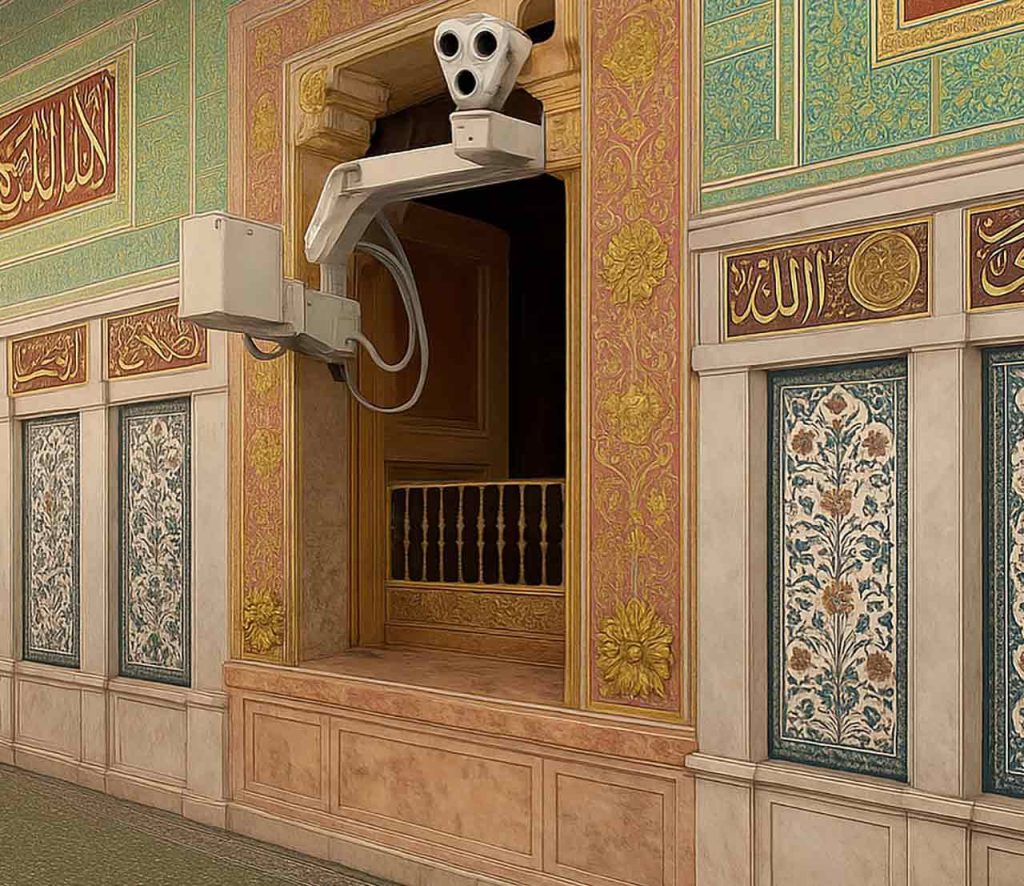
The impasse was finally resolved through the mediation of her brother, Abdullah bin Umar. Hafsah agreed to vacate her home for the public good, but she stipulated one historical condition: her new residence, built nearby, must have a window that aligned perfectly with the Prophet’s resting place. Furthermore, she demanded that this window must never be closed or obstructed by any future construction.
A Legacy Maintained by Empires
What began as a personal request from a grieving widow transformed into a sacred trust (amanah) for every Muslim ruler that followed. From the Umayyads and Abbasids to the Ottomans and the modern Saudi state, the “Window of Hafsah” has been meticulously preserved.
As the mosque underwent massive technological and structural transformations—evolving from a simple courtyard to a world-class architectural marvel—the alignment of Hafsah’s window remained a fixed point. It stands today as a physical manifestation of Adab (etiquette) and respect for the household of the Prophet.
More Than Architecture
For the modern visitor, the window serves as a poignant reminder of the “Prophetic Household”—a home defined by simplicity and an extraordinary depth of character. It challenges the observer to reflect on a love so potent that even the necessity of urban expansion had to bow to it.
The Window of Hafsah is a silent narrator of Islamic history. it tells of a woman’s sacrifice for her community and a community’s enduring loyalty to her memory. In a world of constant change, the window remains a fixed gaze of devotion, proving that in the heart of Madinah, some promises are eternal.